


LSU Paths to PhD: Hannah Perkins Stark Explores How Work Stress Disrupts Healthy Sleep
May 13, 2026
After a decade of research, mentorship, and academic growth at LSU, Hannah Perkins Stark is preparing for her next chapter as a professor and researcher.
A doctoral candidate receiving her PhD in Industrial-Organizational Psychology, Stark studies how workplace stress, unfinished tasks, and supportive supervisors affect employee well-being and sleep health. Her work combines advanced research methods with practical questions about how organizations can better support workers in their daily lives.
Fun Fact about Stark: “As someone who loves a good to-do list and is pretty strict about getting a full eight hours of sleep each night, my PhD research is definitely a bit of ‘me-search.’”
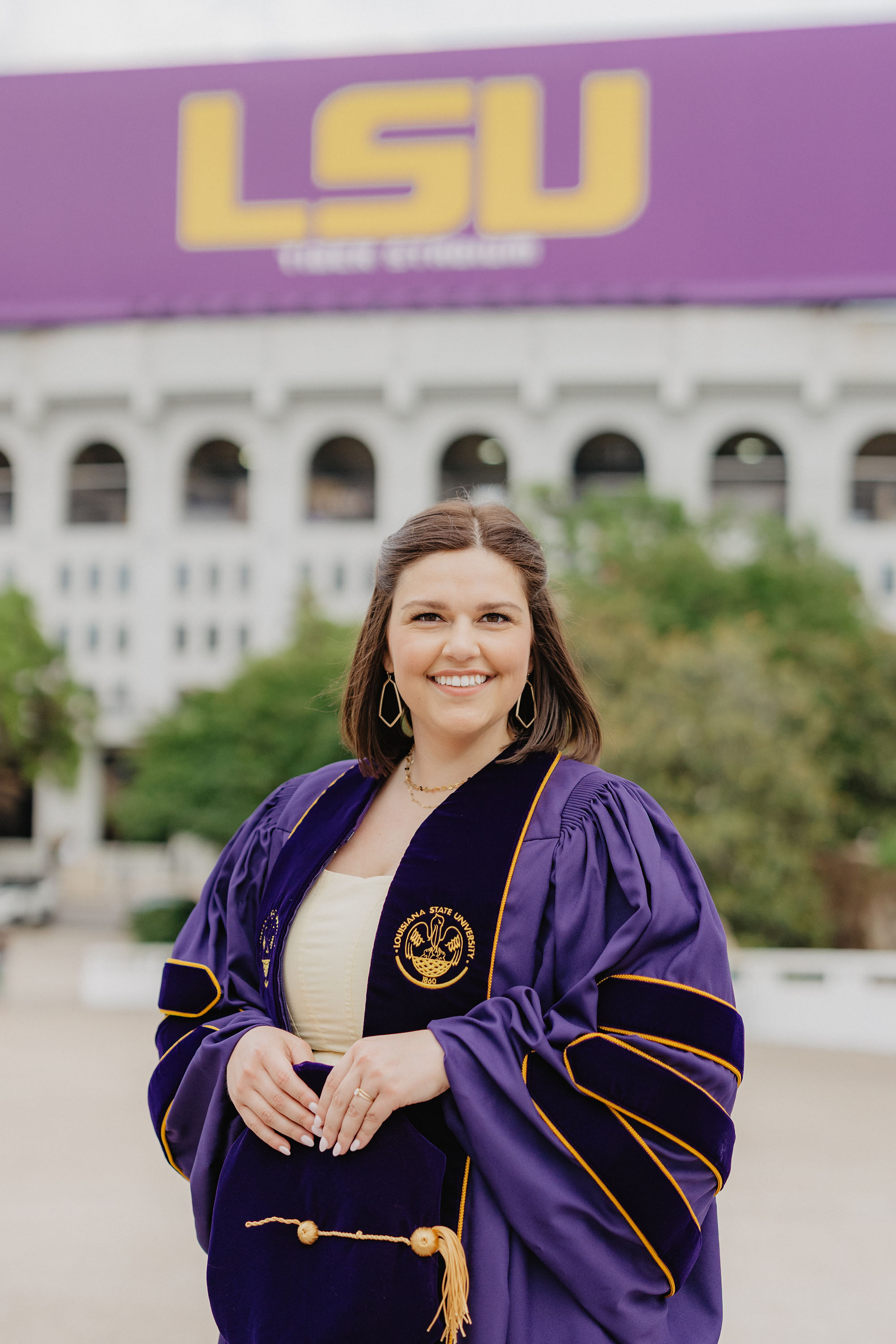
Hannah Perkins Stark, doctoral candidate in Industrial-Organizational Psychology
– Emily Green Photo (Instagram: @emilygreenphoto)
What interested you initially about your thesis research topic?
I first got involved in Industrial-Organizational Psychology research at LSU for my undergraduate honors thesis, and ever since then, I’ve been interested in:
- Understanding how workers’ health and well-being are impacted by work-related and personal stress.
- Identifying ways that supervisors and organizations can better support their employees.
With that in mind, I designed my PhD thesis study to explore how people think about their day-to-day unfinished tasks, whether those thoughts prevent us from sleeping well at night, and whether having a supportive supervisor can help protect employees’ sleep.
What were some of the biggest challenges in your project and how did you overcome them?
I used a daily-dairy design, which meant asking working adults to complete two surveys a day for four days in a row. Understandably, people are busy, and remembering to complete all eight surveys on top of work and personal responsibilities can be difficult.
Because of that, I ended up collecting about 87% of my target sample size. One thing I’ve learned through research, though, is that science is a collective effort. Even when an individual study has limitations, its findings still contribute valuable information that can be considered alongside other studies as researchers work toward a better understanding of employee health and well-being.
What were some of the most surprising or impactful things that you found or learned during your project? What are the implications of your findings?
One of the most impactful things I learned is just how difficult it can be for people to stop thinking about their unfinished tasks before bed, and that these thoughts can interfere with employees’ sleep.
More broadly, my research experiences across the projects I’ve worked on during graduate school have taught me that organizations and supervisors play an important role in protecting and promoting the well-being of employees.
I’m excited to continue exploring the practical things that organizations and supervisors can do to support their employees as they manage work-related stress.
What are your plans after graduation?
After graduation, I’ll be moving to Roanoke, Virginia, where I’ll be starting as an Assistant Professor of Psychology at Hollins University this fall! The first thing on my to-do list is getting my lab space set up and finding students who are excited to help me continue researching employee health and well-being.
What will you take away from your PhD research experience at LSU?
The biggest takeaway from my research experiences at LSU has been the value of both resilience and mentorship. Research can be a long, slow-moving process that doesn’t always provide immediate rewards, so I’ve learned the importance of celebrating small wins along the way (even something as simple as finishing a single paragraph).
I’ve also had the privilege of working with incredible mentors over the past 10 years while also mentoring undergraduate students in research labs myself. Those experiences helped me realize how passionate I am about mentoring student researchers and shaped the kind of mentor I hope to be for my future students.