


LSU Paths to PhD: Physics Student Advances Personalized Cancer Radiotherapy Through Treatment Dashboard
May 08, 2026
Chloe DiTusa knew she loved physics from an early age—her father, sister, and brother are all physicists. But as a Physics and Astronomy PhD candidate graduating this May, she’s applying physics to an area many might not readily associate with physics: cancer medicine.
In her doctoral dissertation, “Making the Right Decisions for Adaptive Radiotherapy,” DiTusa describes a web-based dashboard she built to help compute the metrics needed to modify radiation dose and treatment plans on a daily basis for cancer patients undergoing radiotherapy, because a patient’s anatomy is not static and also changes daily.
Did you know? Natural body processes, such as arriving for prostate cancer treatment with a fuller bladder, can actually help improve radiotherapy treatment delivery. In effect, something as simple and natural as hydration can become part of treatment optimization.
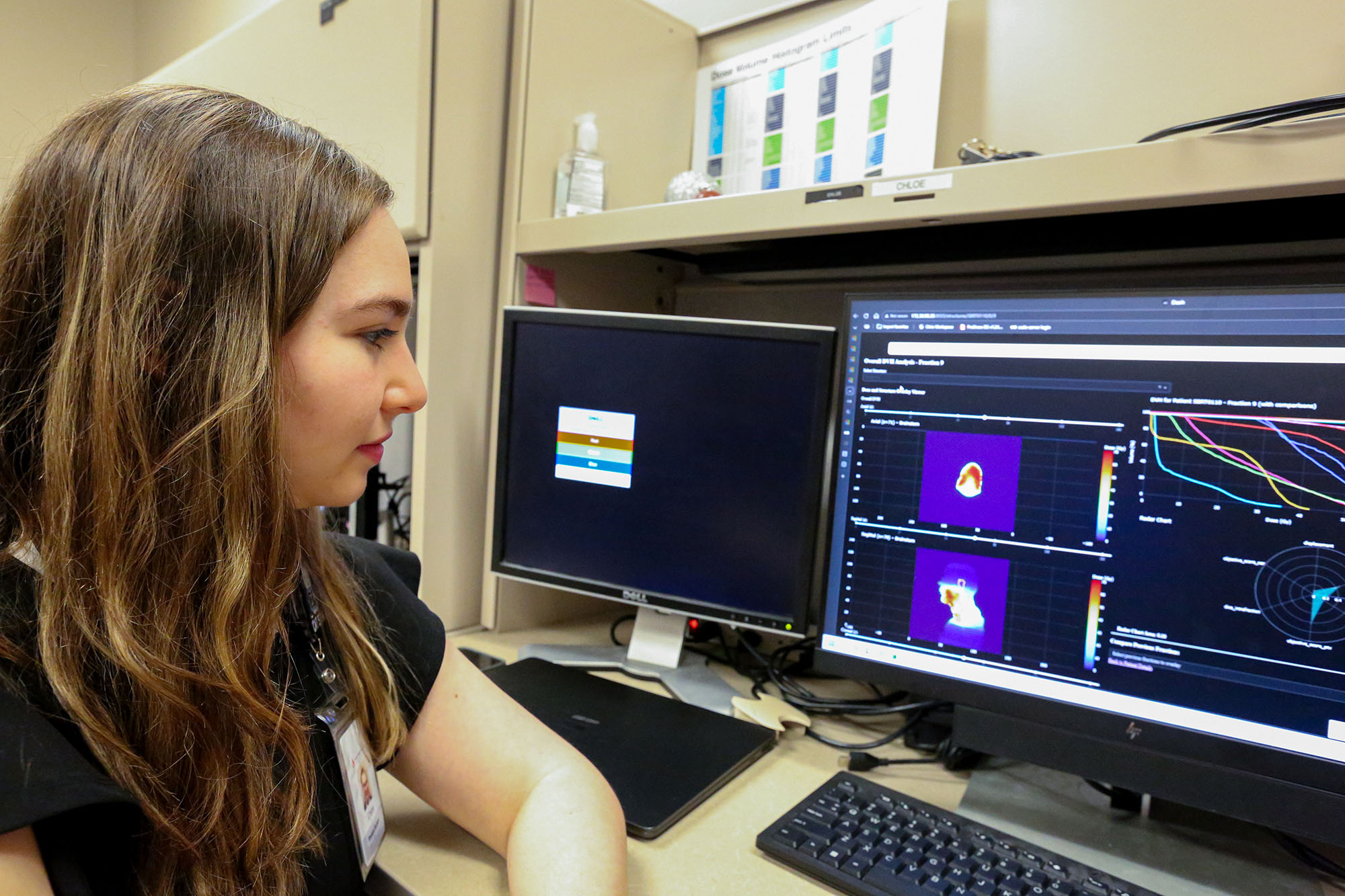
LSU Physics and Astronomy doctoral candidate Chloe DiTusa
We ask DiTusa to tell us more about her doctoral work and experience at LSU.
What interested you initially about your thesis research topic? How did you get into medical physics?
I have always been interested in improving medicine by moving away from a “one-size-fits-all” approach and toward care that is tailored to the individual patient. That interest is what initially drew me to Adaptive Radiotherapy.
I appreciated that it focused on the patient as an individual and recognized that the body changes throughout treatment rather than assuming it remains completely stable. Being able to contribute to research that supports a more personalized approach to care was something that immediately resonated with me.
My path into medical physics began while I was studying physics as an undergraduate.
Early in college, someone close to me was diagnosed with cancer, and watching them go through treatment had a profound impact on me. At the time, it was difficult feeling like there was nothing meaningful I could do to help.
When I was introduced to medical physics and research in radiation oncology, it changed that perspective entirely. I became deeply interested in understanding the treatments patients undergo, how those treatments could be improved, and how research could contribute to a better experience for future patients.
That combination of physics, innovation, and direct impact on patient care gave me a strong sense of purpose and ultimately led me to pursue medical physics as a career.
What is your favorite fun fact about your research topic?
One fun fact about radiotherapy is that natural body processes can actually help improve treatment delivery. In many prostate cancer treatments, patients are asked to arrive with a fuller bladder because bladder filling changes the position of the prostate and surrounding anatomy.
These anatomical changes can help reduce radiation exposure to nearby radiosensitive organs, such as the rectum, while maintaining dose coverage to the target. I always found it fascinating that something as simple and natural as hydration can become part of treatment optimization.
Can you tell us more about making the adaptive cancer treatment dashboard and what that entailed?
Developing the dashboard was one of the most rewarding parts of my research because it combined technical problem-solving with clinical usability.
Early in the project, a major focus was on determining what information would be most valuable to clinicians, how that information should be displayed, and how the dashboard could fit naturally into a clinical workflow.
Once those goals were established, the next challenge was designing and building a system to organize large volumes of treatment data into a format that was both efficient and user-friendly.
A large part of the development process involved expanding my programming experience, particularly in Python and web-based application design. I was already familiar with backend development and data processing, but creating an interactive user interface introduced a completely different set of challenges.
Instead of simply analyzing data behind the scenes, the project required building tools that allowed users to interact with the data directly through the dashboard itself. That process involved a great deal of iteration, troubleshooting, and learning, but it was also incredibly rewarding to see the system gradually evolve into a functional clinical research tool.
What were some of the biggest challenges in your project, and how did you overcome them?
One of the biggest challenges was building a system that not only functioned technically but also accurately represented complex medical data in a clinically meaningful way. A large part of the work involved ensuring that calculations related to dose, structures, and treatment metrics were both correct and consistent with how the data is interpreted in practice.
At the same time, the dashboard itself had to be stable and user-friendly, which meant constantly testing, refining, and validating both the backend logic and how the results were displayed. Overcoming this required a lot of iterative development, careful validation against expected clinical behavior, and continuous refinement until the tool was both reliable and usable.
What were some of the most surprising or impactful things that you found or learned during your project? What are the implications?
One of the most impactful findings from this project was that anatomical changes affect treatment differently depending on the disease site, and that these differences shape what needs to be monitored during therapy.
In head and neck cases, gradual changes such as weight loss can alter patient geometry over time and lead to deviations from the original planned dose distribution. In prostate treatments, especially in shorter hypofractionated courses, day-to-day variations in bladder and rectal filling can cause more immediate shifts in anatomy and dose to nearby organs.
What became clear is that these differences are not only clinically important but also measurable using the geometric, dosimetric, and radiobiological metrics developed in the dashboard, highlighting that meaningful adaptive assessment must be tailored to the specific patterns of variation at each treatment site.
What are your plans after graduation? What will you take away from your PhD research experience at LSU?
I will attend residency at the University of Miami. My PhD at LSU gave me the opportunity to build a strong foundation in both the technical and clinical aspects of the field. I developed hands-on experience with commonly used medical physics software and gained a better understanding of how these tools are applied in clinical practice.
At the same time, I learned how to go beyond using existing systems and contribute to building new tools that can support and improve cancer treatment. Overall, the experience reinforced how physics, computation, and clinical medicine come together to shape patient care, and it gave me both the skills and perspective to continue growing in this field.